PART ONE. ENGINEERING LIMITS OF UNDERGROUND VOICE COMMUNICATION
Scientific Perspective.
Despite impressive technological progress in many industries, creating an effective — or even simply reliable — voice communication system in mines remains a difficult engineering challenge. Why? There are many reasons why underground voice communication develops slowly and encounters significant obstacles.
Physics, geology, and chemistry — the sciences that normally drive technological advancement — in this case work against us. Rock formations, especially those that are moist or contain metallic ores, act as effective shields against most types of electromagnetic radiation used in conventional radio communication.
The frequency paradox: Low frequencies (tens to hundreds of kHz) penetrate rock formations more effectively but require extremely large antennas and provide very limited bandwidth, insufficient for high-quality voice transmission. High frequencies (VHF, hundreds of MHz) are suitable for voice communication, but their penetration capability in rock masses is measured in meters rather than kilometers.
Geometric complexity of underground space: Mines are not straight tunnels but complex three-dimensional labyrinths featuring sharp turns and bends, multi-level structures with vertical shafts and inclined drifts, continuously changing geometry as mining progresses, and varying cross-sections ranging from narrow headings to large chambers. Such geometry creates extremely challenging conditions for wave propagation, including both radio and acoustic signals.
Technological Perspective.
Even when a workable communication technology is developed, deployment faces unique challenges:
Power supply for communication systems introduces additional complications:
Continuous advancement of mining faces requires regular relocation of equipment. Rock collapses may destroy installed infrastructure, while temporary workings complicate permanent system deployment.
Economic Perspective.
Existing underground communication systems must balance coverage area, network capacity, voice quality, energy efficiency, and cost. A key constraint — often underestimated during system design — is the geometry of underground workings itself.
Communication infrastructure may need to cover tens of kilometers of tunnels, while reliable communication is actually required only in limited operational zones — typically no more than 10% of total workings, mainly active faces and dead-end areas where activity changes most rapidly.
This creates situations where companies invest heavily in large-scale infrastructure primarily to serve localized high-value operational zones, resulting in compromise solutions that are not always optimal.
An additional challenge is incompatibility between backbone infrastructure and portable devices, both within individual sites and across enterprise groups. The emergence of a technological “zoo” increases certification, maintenance, and spare-part inventory costs while reducing overall system manageability and efficiency.
Ergonomic Perspective.
Even when engineers solve signal propagation problems underground, the final link — the human-device interface — becomes an enormous challenge. A miner wearing full protective equipment essentially operates within one of the most electronics-unfriendly environments on Earth.
The helmet, a critical safety element, covers much of the head, preventing communication devices from being positioned near the ear and blocking acoustic wave propagation. Shouting into a radio attached to a belt becomes ineffective.
Mounting microphones and headphones on the helmet seems obvious, yet introduces new problems:
Protruding components are easily damaged in confined workings or during movement through narrow passages. Heat and perspiration create a microclimate beneath the helmet, quickly saturating acoustic components with moisture, causing discomfort, skin irritation, and electronic failure.
Respirators and Self-Rescuers: Default Silent Mode
When working in dusty environments — or critically, during emergencies such as fires, methane releases, or smoke — miners wear respirators or activate self-rescuers. Ironically, this is when communication is needed most, yet becomes fundamentally limited.
The key issue lies not in microphones or headsets but in the operating principle of the self-rescuer itself. When activated, the miner breathes through a mouthpiece that completely occupies the oral cavity. Under such conditions, articulate speech becomes physically impossible; only muffled, unintelligible sounds can be produced. This limitation cannot be eliminated by wired or wireless headsets.
Even respirators without mouthpieces tightly seal the face. External microphones capture only distorted sound. Placing microphones inside masks requires redesigning certified protective equipment, ensuring airtight integrity, and re-certifying the entire system — dramatically increasing cost and complexity. Under stress and heavy breathing, speech becomes fragmented and difficult to recognize even under ideal acoustic conditions.
Wired headsets introduce additional risks underground. Extra cables in environments filled with rock protrusions, supports, and moving equipment present serious safety hazards. Cables may become trapped, entangled in rotating mechanisms, or suddenly tensioned, potentially injuring workers. Moisture, dust, and vibration quickly damage connectors, causing communication failure at critical moments.
Wireless headsets provide only an illusion of freedom. Their main vulnerability is power consumption. Standard Bluetooth devices are not designed for 8–12 hour shifts with active communication, and during emergencies lasting many hours or days, discharged devices become useless. Charging hundreds of headsets underground represents a complex operational challenge. Additionally, underground radio channels suffer interference from electrical equipment and power cables.
Thus, in dusty or emergency conditions, the issue is not choosing a “better headset” but confronting a fundamental limitation of voice communication itself. Once a self-rescuer is activated, miners effectively lose the ability to speak, rendering systems that ignore this factor ineffective precisely when communication is most critical.
Gloves and Control Interfaces
Even with a perfect communication device, it must be operated using heavy, wet, and dirty gloves. Small radio buttons or smartphone touchscreens become unusable.
Control must rely on:
The challenge is not transmitting voice through kilometers of rock — it is capturing clear speech from a miner wearing a helmet and respirator, working in 40°C heat amid machinery noise, without communication equipment interfering with work or survival.
This requires fundamentally different industrial design, where communication devices become integrated elements of personal protective equipment rather than standalone gadgets. Developing such solutions demands collaboration between communication engineers, acoustics specialists, materials scientists, physiologists, and — most importantly — miners themselves, whose real-world feedback eliminates impractical concepts.
Without solving these “last 10 centimeters” — from mouth to microphone and ear to speaker — even the most advanced underground network will remain an impressive but ineffective technological solution.
PART TWO. SOLUTIONS AND PROSPECTS: EXPERIENCE MATTERS
When discussing underground communication, universal solutions do not exist — only compromises validated under real operating conditions. This applies to currently deployed systems, including our own solutions: they are not without limitations and require further development. Nevertheless, they represent today’s most mature and technologically advanced approaches. Therefore, discussing future prospects is impossible without practical operational experience.
In underground communication projects, VoIP solutions based on the open-source Asterisk platform combined with Wi-Fi phones (Strata, ECom) have been implemented. This approach offers relatively simple deployment, configuration flexibility, and integration into existing customer infrastructure. In stable mining areas with predictable geometry, such solutions remain practical and economically justified.
Traditional professional radio communication systems, including Hytera equipment, have also been widely used. Radio communication remains popular due to its simplicity and familiar user interface. However, underground limitations become particularly evident: rock shielding, dependence on repeaters, signal degradation caused by equipment movement, and infrastructure vulnerability during operations or collapses.
Operational experience with such systems revealed a key issue: communication networks built around stationary infrastructure adapt poorly to the dynamic nature of mining operations. Mining faces advance, routes change, equipment moves — and networks constantly require reconfiguration or restoration.
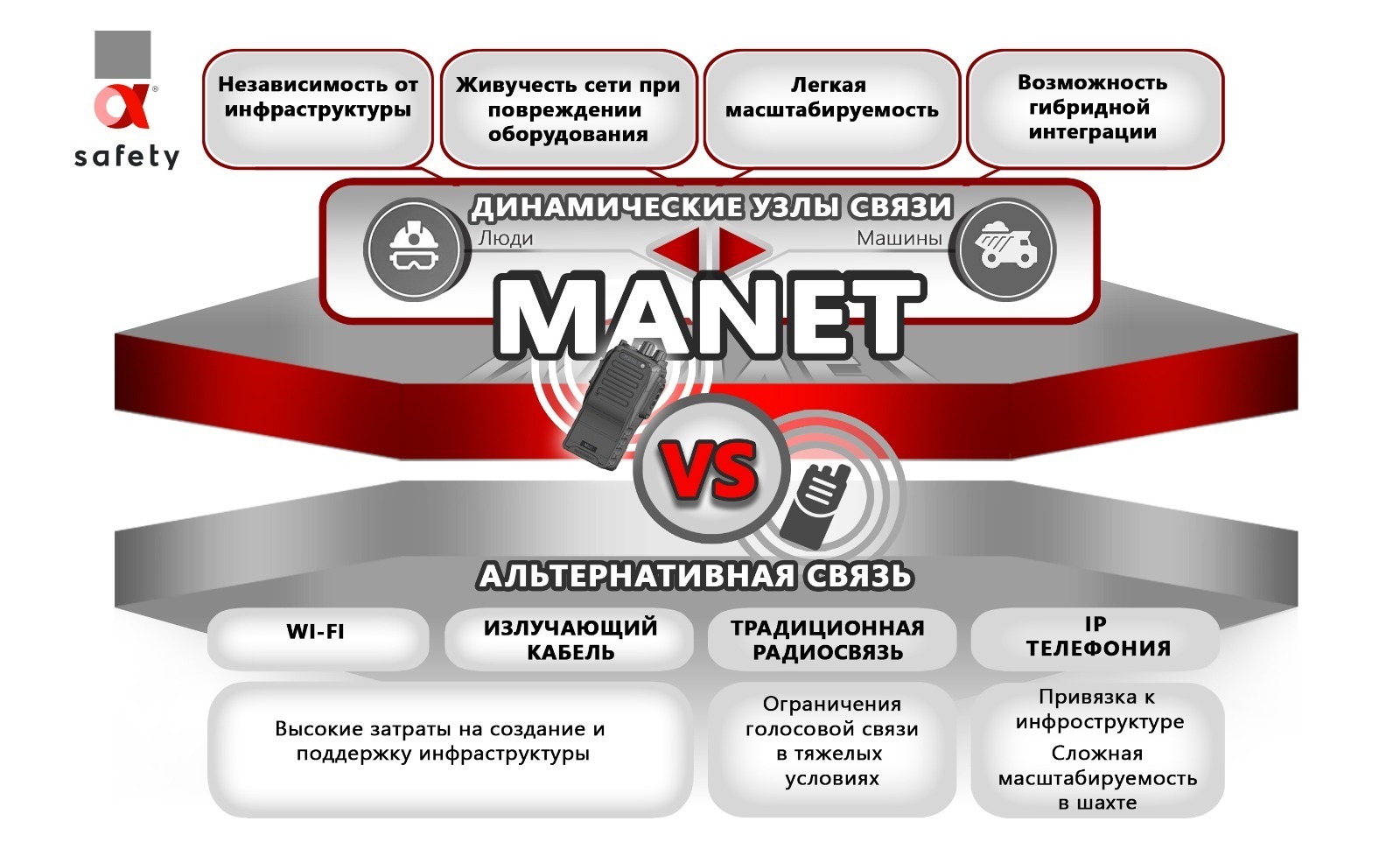
This realization led to the next development stage: transition toward self-organizing networks (MANET / mesh), fundamentally changing communication logic. In current projects, Alpha Safety specialists increasingly evaluate solutions based on Regulus MANET, where network nodes are formed by devices carried by personnel and installed on machines. Networks form dynamically, transmission routes automatically rebuild, and loss of individual nodes does not cause total communication failure.
From a technical perspective, this enables:
However, even these technologies are not a “silver bullet.” Practical experience shows that the future of underground communication lies not in replacing one technology with another, but in hybridization — combining wired and wireless systems, VoIP, radio channels, and MANET networks depending on site-specific conditions.
Within this context, text communication is gaining renewed importance in emergency scenarios. Despite appearing outdated, it allows reliable transmission of critical information when voice communication becomes limited or impossible.
The key trend is clear: voice communication is no longer an independent system. It is becoming part of a unified digital ecosystem integrating communication, positioning, worker and equipment monitoring, telemetry, and safety event management. In this form, communication fulfills its primary purpose — serving not merely as a voice channel but as a real-time risk management and decision-making tool.
Thus, the development of underground communication represents not a technological race but a gradual engineering evolution based on practical operational experience. Our own experience allows us to discuss future prospects not as theory, but as the logical continuation of an already established path.
Scientific Perspective.
Despite impressive technological progress in many industries, creating an effective — or even simply reliable — voice communication system in mines remains a difficult engineering challenge. Why? There are many reasons why underground voice communication develops slowly and encounters significant obstacles.
Physics, geology, and chemistry — the sciences that normally drive technological advancement — in this case work against us. Rock formations, especially those that are moist or contain metallic ores, act as effective shields against most types of electromagnetic radiation used in conventional radio communication.
The frequency paradox: Low frequencies (tens to hundreds of kHz) penetrate rock formations more effectively but require extremely large antennas and provide very limited bandwidth, insufficient for high-quality voice transmission. High frequencies (VHF, hundreds of MHz) are suitable for voice communication, but their penetration capability in rock masses is measured in meters rather than kilometers.
Geometric complexity of underground space: Mines are not straight tunnels but complex three-dimensional labyrinths featuring sharp turns and bends, multi-level structures with vertical shafts and inclined drifts, continuously changing geometry as mining progresses, and varying cross-sections ranging from narrow headings to large chambers. Such geometry creates extremely challenging conditions for wave propagation, including both radio and acoustic signals.
Technological Perspective.
Even when a workable communication technology is developed, deployment faces unique challenges:
- hostile environments with explosive atmospheres (methane, coal dust);
- extremely high humidity levels (up to 100%), sometimes including flooding;
- chemically aggressive water causing corrosion even before equipment installation;
- mechanical damage from machinery operations and rockfalls;
- elevated temperatures at great depths.
Power supply for communication systems introduces additional complications:
- limited cable routing options;
- strict explosion-proof equipment requirements;
- difficulties installing and maintaining power sources in remote workings.
Continuous advancement of mining faces requires regular relocation of equipment. Rock collapses may destroy installed infrastructure, while temporary workings complicate permanent system deployment.
Economic Perspective.
Existing underground communication systems must balance coverage area, network capacity, voice quality, energy efficiency, and cost. A key constraint — often underestimated during system design — is the geometry of underground workings itself.
Communication infrastructure may need to cover tens of kilometers of tunnels, while reliable communication is actually required only in limited operational zones — typically no more than 10% of total workings, mainly active faces and dead-end areas where activity changes most rapidly.
This creates situations where companies invest heavily in large-scale infrastructure primarily to serve localized high-value operational zones, resulting in compromise solutions that are not always optimal.
An additional challenge is incompatibility between backbone infrastructure and portable devices, both within individual sites and across enterprise groups. The emergence of a technological “zoo” increases certification, maintenance, and spare-part inventory costs while reducing overall system manageability and efficiency.
Ergonomic Perspective.
Even when engineers solve signal propagation problems underground, the final link — the human-device interface — becomes an enormous challenge. A miner wearing full protective equipment essentially operates within one of the most electronics-unfriendly environments on Earth.
The helmet, a critical safety element, covers much of the head, preventing communication devices from being positioned near the ear and blocking acoustic wave propagation. Shouting into a radio attached to a belt becomes ineffective.
Mounting microphones and headphones on the helmet seems obvious, yet introduces new problems:
- microphones positioned 5–10 cm from the mouth capture breathing and environmental noise rather than speech;
- surrounding sounds such as water flow, wind, pipelines, metal scraping, and machinery overwhelm noise suppression filters.
Protruding components are easily damaged in confined workings or during movement through narrow passages. Heat and perspiration create a microclimate beneath the helmet, quickly saturating acoustic components with moisture, causing discomfort, skin irritation, and electronic failure.
Respirators and Self-Rescuers: Default Silent Mode
When working in dusty environments — or critically, during emergencies such as fires, methane releases, or smoke — miners wear respirators or activate self-rescuers. Ironically, this is when communication is needed most, yet becomes fundamentally limited.
The key issue lies not in microphones or headsets but in the operating principle of the self-rescuer itself. When activated, the miner breathes through a mouthpiece that completely occupies the oral cavity. Under such conditions, articulate speech becomes physically impossible; only muffled, unintelligible sounds can be produced. This limitation cannot be eliminated by wired or wireless headsets.
Even respirators without mouthpieces tightly seal the face. External microphones capture only distorted sound. Placing microphones inside masks requires redesigning certified protective equipment, ensuring airtight integrity, and re-certifying the entire system — dramatically increasing cost and complexity. Under stress and heavy breathing, speech becomes fragmented and difficult to recognize even under ideal acoustic conditions.
Wired headsets introduce additional risks underground. Extra cables in environments filled with rock protrusions, supports, and moving equipment present serious safety hazards. Cables may become trapped, entangled in rotating mechanisms, or suddenly tensioned, potentially injuring workers. Moisture, dust, and vibration quickly damage connectors, causing communication failure at critical moments.
Wireless headsets provide only an illusion of freedom. Their main vulnerability is power consumption. Standard Bluetooth devices are not designed for 8–12 hour shifts with active communication, and during emergencies lasting many hours or days, discharged devices become useless. Charging hundreds of headsets underground represents a complex operational challenge. Additionally, underground radio channels suffer interference from electrical equipment and power cables.
Thus, in dusty or emergency conditions, the issue is not choosing a “better headset” but confronting a fundamental limitation of voice communication itself. Once a self-rescuer is activated, miners effectively lose the ability to speak, rendering systems that ignore this factor ineffective precisely when communication is most critical.
Gloves and Control Interfaces
Even with a perfect communication device, it must be operated using heavy, wet, and dirty gloves. Small radio buttons or smartphone touchscreens become unusable.
Control must rely on:
- large physical buttons (power / talk);
- voice commands (problematic under high noise levels);
- automated activation (for example, triggered by shouting or fall detection).
The challenge is not transmitting voice through kilometers of rock — it is capturing clear speech from a miner wearing a helmet and respirator, working in 40°C heat amid machinery noise, without communication equipment interfering with work or survival.
This requires fundamentally different industrial design, where communication devices become integrated elements of personal protective equipment rather than standalone gadgets. Developing such solutions demands collaboration between communication engineers, acoustics specialists, materials scientists, physiologists, and — most importantly — miners themselves, whose real-world feedback eliminates impractical concepts.
Without solving these “last 10 centimeters” — from mouth to microphone and ear to speaker — even the most advanced underground network will remain an impressive but ineffective technological solution.
PART TWO. SOLUTIONS AND PROSPECTS: EXPERIENCE MATTERS
When discussing underground communication, universal solutions do not exist — only compromises validated under real operating conditions. This applies to currently deployed systems, including our own solutions: they are not without limitations and require further development. Nevertheless, they represent today’s most mature and technologically advanced approaches. Therefore, discussing future prospects is impossible without practical operational experience.
In underground communication projects, VoIP solutions based on the open-source Asterisk platform combined with Wi-Fi phones (Strata, ECom) have been implemented. This approach offers relatively simple deployment, configuration flexibility, and integration into existing customer infrastructure. In stable mining areas with predictable geometry, such solutions remain practical and economically justified.
Traditional professional radio communication systems, including Hytera equipment, have also been widely used. Radio communication remains popular due to its simplicity and familiar user interface. However, underground limitations become particularly evident: rock shielding, dependence on repeaters, signal degradation caused by equipment movement, and infrastructure vulnerability during operations or collapses.
Operational experience with such systems revealed a key issue: communication networks built around stationary infrastructure adapt poorly to the dynamic nature of mining operations. Mining faces advance, routes change, equipment moves — and networks constantly require reconfiguration or restoration.
This realization led to the next development stage: transition toward self-organizing networks (MANET / mesh), fundamentally changing communication logic. In current projects, Alpha Safety specialists increasingly evaluate solutions based on Regulus MANET, where network nodes are formed by devices carried by personnel and installed on machines. Networks form dynamically, transmission routes automatically rebuild, and loss of individual nodes does not cause total communication failure.
From a technical perspective, this enables:
- elimination of strict dependence on cable infrastructure;
- improved network survivability during emergencies;
- natural scalability alongside mining development;
- hybrid integration with existing VoIP and radio systems.
However, even these technologies are not a “silver bullet.” Practical experience shows that the future of underground communication lies not in replacing one technology with another, but in hybridization — combining wired and wireless systems, VoIP, radio channels, and MANET networks depending on site-specific conditions.
Within this context, text communication is gaining renewed importance in emergency scenarios. Despite appearing outdated, it allows reliable transmission of critical information when voice communication becomes limited or impossible.
The key trend is clear: voice communication is no longer an independent system. It is becoming part of a unified digital ecosystem integrating communication, positioning, worker and equipment monitoring, telemetry, and safety event management. In this form, communication fulfills its primary purpose — serving not merely as a voice channel but as a real-time risk management and decision-making tool.
Thus, the development of underground communication represents not a technological race but a gradual engineering evolution based on practical operational experience. Our own experience allows us to discuss future prospects not as theory, but as the logical continuation of an already established path.