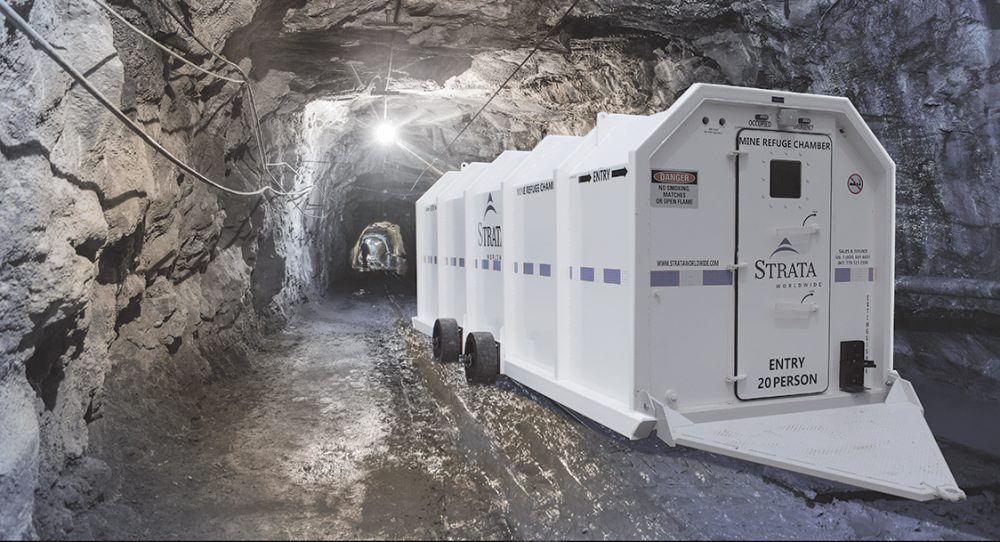
ERCs are designed to save lives and protect people's health when evacuation is not possible. They must ensure the survival of personnel in conditions of complete isolation from the external environment.
The problem of mine safety
Despite technological advances, the safety of underground mining operations remains one of the most pressing issues in the industry. The main causes of danger are:
Tragedies such as the accident at the Raspadskaya mine in 2010, where 91 people died, showed that existing measures do not guarantee survival. Many miners suffocated, just a few dozen meters from the exit. These events forced experts to rethink their approach to rescue systems and consider the introduction of collective protection measures.
Purpose and functions of emergency rescue chambers
The chambers are an alternative means of rescue and are designed to preserve human life and health when evacuation is not possible. They must ensure the survival of personnel in conditions of complete isolation from the external environment. Main functions:
In fact, an emergency rescue chamber is a miniature shelter that can save dozens of lives by providing autonomous existence for 24–96 hours until the arrival of mountain rescuers.
Types and classification of rescue chambers
The variety of underground working conditions requires different types of emergency rescue chambers, adapted to the depth, geology, and infrastructure of the mine. The main types are:
Each type has its own advantages. Mobile models are easier to install in existing mines, while stationary models provide greater autonomy. Modern manufacturers, such as Strata, offer kits tailored to individual customer requirements, including the option of connecting to mine systems or operating in fully autonomous mode.
Global practice in the use of emergency rescue chambers
In developed mining countries, rescue chambers have become a mandatory safety feature. The most well-known examples are:
Global practice proves that the presence of emergency rescue chambers significantly reduces mortality in accidents. Where they are installed, the number of victims in similar incidents is minimal.
Economic and organizational aspects
The introduction of emergency rescue chambers require investment, but its cost is incomparable to the losses from accidents. The main factors of economic feasibility are:
It is important to position cameras correctly—every 500–600 meters from workplaces along evacuation routes—to regularly check systems for readiness, and to train personnel. Emergency rescue chambers are becoming not just equipment, but an element of safety culture.
Prospects for the development of rescue technologies
The future of mining is impossible without improving collective rescue systems. The main areas of development are:
These technologies make the emergency rescue chamber not just a shelter, but a complete survival system — smart, autonomous, and reliable.
The problem of mine safety
Despite technological advances, the safety of underground mining operations remains one of the most pressing issues in the industry. The main causes of danger are:
- Limited evacuation options. In the event of an accident, escape routes are often blocked by collapses or fire, and the oxygen supply in individual self-rescuers is only enough for 30-60 minutes.
- Long distances. In mines that are tens of kilometers long, people often have to travel several kilometers to reach fresh air.
- Ventilation failure. After explosions and fires, the ventilation system can be completely destroyed, creating a deadly atmosphere.
- Lack of collective protection measures. For a long time, there was only a single-stage self-rescue system that did not provide for temporary shelter underground.
Tragedies such as the accident at the Raspadskaya mine in 2010, where 91 people died, showed that existing measures do not guarantee survival. Many miners suffocated, just a few dozen meters from the exit. These events forced experts to rethink their approach to rescue systems and consider the introduction of collective protection measures.
Purpose and functions of emergency rescue chambers
The chambers are an alternative means of rescue and are designed to preserve human life and health when evacuation is not possible. They must ensure the survival of personnel in conditions of complete isolation from the external environment. Main functions:
- Isolation from toxic gases and smoke. The airtight design prevents the penetration of carbon monoxide and combustion products.
- Maintaining the breathing environment. The oxygen regeneration and carbon dioxide removal system maintains a safe air composition.
- Life support. The chamber is equipped with water, food, a first aid kit, and a bio-toilet.
- Communication and alerting. Radio communication and light signals allow rescuers to quickly locate the shelter, and communication with the surface helps coordinate rescue efforts.
- Psychological factor. Lighting, the ability to communicate, and a comfortable temperature help people stay calm.
In fact, an emergency rescue chamber is a miniature shelter that can save dozens of lives by providing autonomous existence for 24–96 hours until the arrival of mountain rescuers.
Types and classification of rescue chambers
The variety of underground working conditions requires different types of emergency rescue chambers, adapted to the depth, geology, and infrastructure of the mine. The main types are:
- Compact and mobile emergency rescue chambers. Mobile shelters that can be moved along with the mining front. Designed for 4-6 people.
- Segmented rescue chambers. Consists of modules that are hermetically connected underground. Easy to transport, even in cages, and can be extended if necessary.
- Tunnel emergency rescue chambers. Designed for placement in long mining workings and transport tunnels, has an elongated shape.
- Frameless emergency rescue chambers. A rapidly deployable inflatable structure that provides temporary shelter in confined spaces.
Each type has its own advantages. Mobile models are easier to install in existing mines, while stationary models provide greater autonomy. Modern manufacturers, such as Strata, offer kits tailored to individual customer requirements, including the option of connecting to mine systems or operating in fully autonomous mode.
Global practice in the use of emergency rescue chambers
In developed mining countries, rescue chambers have become a mandatory safety feature. The most well-known examples are:
- The USA and Australia. Strata chambers are used everywhere and are equipped with air regeneration, communication, and cooling systems.
- Chile, 2010. Thanks to the emergency rescue chamber, 33 miners survived for 17 days until communication was established and were rescued three months later.
- Tasmania, 2006. Three miners survived an underground fire by taking refuge in a chamber and waiting for help.
- Kazakhstan. The first Strata emergency rescue chambers were installed in mines in the East Kazakhstan region in 2019 — a successful example of the adaptation of global technology in the EAEU.
Global practice proves that the presence of emergency rescue chambers significantly reduces mortality in accidents. Where they are installed, the number of victims in similar incidents is minimal.
Economic and organizational aspects
The introduction of emergency rescue chambers require investment, but its cost is incomparable to the losses from accidents. The main factors of economic feasibility are:
- Reduction of human losses. The lives of miners are of the highest value, and every life saved justifies any cost.
- Reducing reputational and social costs. Companies that invest in safety increase the trust of the state and employees.
- Minimization of downtime. Rapid response and localization of accidents reduce losses.
- Compliance with regulations. Compliance with industrial safety rules and GOST standards is a prerequisite for the operation of modern mines.
It is important to position cameras correctly—every 500–600 meters from workplaces along evacuation routes—to regularly check systems for readiness, and to train personnel. Emergency rescue chambers are becoming not just equipment, but an element of safety culture.
Prospects for the development of rescue technologies
The future of mining is impossible without improving collective rescue systems. The main areas of development are:
- Digitalization. Smart sensors transmit atmospheric parameters and shelter coordinates in real time.
- Energy efficiency. New power sources and air regeneration extend the autonomy of the emergency rescue chambers by more than 96 hours.
- Versatility. Chambers are adapted for subway tunnels, chemical plants, and underground construction sites.
- Modularity. Segmented and frameless structures allow for rapid expansion of the shelter's volume.
These technologies make the emergency rescue chamber not just a shelter, but a complete survival system — smart, autonomous, and reliable.